Sortime - Goods Puzzle Sorting
- 4.4
- Rating
- 1.00M
- Installs
- Free
- Price
 Analysis by App-foxy
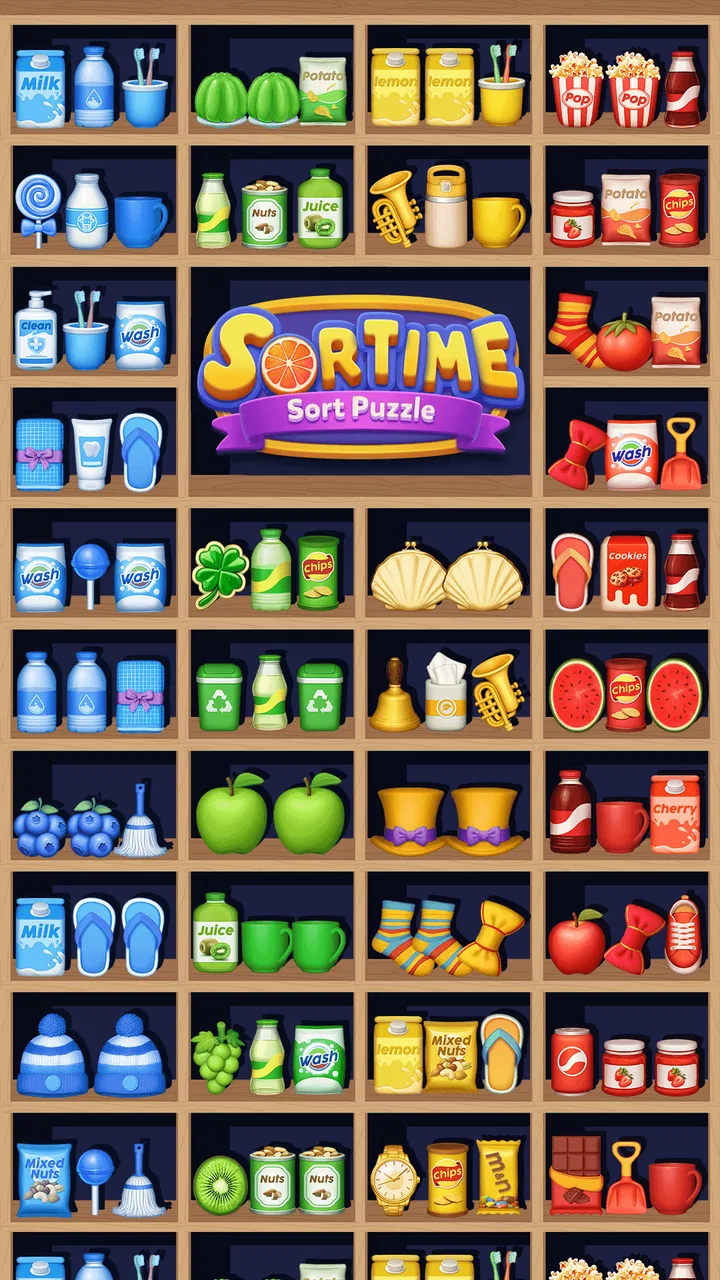
I went into Sortime - Goods Puzzle Sorting expecting a simple matching game, and that is exactly where its appeal begins. You look at a crowded three-dimensional collection of goods, identify items that belong together, and sort them into matching groups. The first move is easy to understand, but the board quickly turns that basic action into a small planning exercise. Every successful match clears visual clutter, gives immediate feedback, and makes the next decision more visible. That steady change from mess to order is the reason I kept starting another round.
This is a free puzzle game from Tap Color Studio, aimed at Everyone and available for devices running Android 6.0 or later. It sits in the casual sorting corner of the puzzle category rather than trying to be a story-driven adventure or a traditional match-three game. The store summary describes it as a 3D goods sorting challenge, but in practice the important point is how physical the board feels: I am not merely swapping colored tiles on a flat grid; I am scanning objects, judging what is available, and deciding which match will make the next useful item easier to reach.
How the sorting loop feels from the first move to the reset
I find the loop most satisfying when I treat the first scan as part of the puzzle, not just a pause before tapping: spotting which match will open up the board can make the next few choices feel much clearer. If a move leaves the layout harder to read, I slow down and reassess rather than chasing the quickest match. That habit also helps explain where the game’s relaxed rhythm can turn into a little friction.
You May Also Like

 Blood Strike: 2.5 Anniversary
Blood Strike’s Loadouts Turn Every Drop Into a Tactical Gamble
A close look at Blood Strike’s custom loadouts: how fast access to signature weapons reshapes its battle royale rhythm, rewards preparation, and narrows the gap between fights.

 Pandora - Music & Podcasts
Pandora’s Music Is Easy to Start, but Harder to Recover
Pandora’s strength is its low-effort path from a seed to a station. Its weak spot is how much confidence it asks you to place in connection, setup, and quiet recovery.

 8 Ball Pool
 Is Built on Rivalries, Rematches, and Routine
A close look at the rivalries, rematches, shared routines, and unanswered safety questions that turn a quick pool match into a persistent mobile community.

 Samsung Music
’s Quiet Strength Is Playing What You Already Own
Its reach comes less from spectacle than from dependable access to a personal library. That simplicity is both the app’s strongest retention engine and its ceiling.

 AccuWeather: Weather Radar
AccuWeather Review: A Quick, Clear Forecast for Everyday Decisions
For everyday plans, the best forecast is the one you can understand quickly. AccuWeather makes rain timing, radar, and local conditions easy to act on, with a few trade-offs.

 Hill Climb Racing
Why Hill Climb Racing Still Turns Crashes Into One More Run
A tiny car, a bumpy hill and one more upgrade: Hill Climb Racing keeps resurfacing because its simple chaos makes every near-miss feel personal.
More From Our News Desk



The first action is simple, but the board asks for attention
The opening move in a level is usually about recognition. I look for a group of similar goods, select the matching pieces, and watch the game confirm that the choice was correct. That immediate response matters because it removes the uncertainty that can make sorting games feel vague. I know when I have made progress, and I can see the cleared space that follows.
The three-dimensional presentation adds a small but meaningful layer of observation. Objects can be visually close without being equally useful, so I learned not to grab the first familiar item I noticed. A better habit is to scan the whole visible area, find the most exposed group, and then consider what its removal will reveal. This is one of the first non-obvious strengths of the game: the best move is not always the quickest match. Sometimes clearing an awkward item opens a route to several easier groups.
That makes the game more engaging than a purely automatic color-matching exercise. I am constantly asking two questions: what can I complete now, and what will become available if I remove something else first? The decision is still light enough for casual play, but it gives the board a sense of consequence. A careless selection can leave the remaining goods arranged in an inconvenient way, while a tidy sequence makes the rest of the puzzle feel almost self-explanatory.
Feedback creates a comfortable rhythm
Once I begin sorting, the game settles into a repeated rhythm: inspect the goods, select a matching group, receive confirmation, and reassess the new layout. The feedback is the heart of the experience. Each cleared set reduces the visual noise, so progress is communicated not only through the response to a tap but also through the changing shape of the board.
I found that rhythm especially suitable for short breaks. A round gives me something concrete to focus on without demanding the long-term commitment of a deeper logic puzzle. It is easy to play while waiting for an appointment or during a quiet pause, because the action is immediately understandable. At the same time, the sorting decisions are enough to keep the session from becoming completely passive.
The strongest moments come when one correct group exposes another. I may begin by clearing a visible set, notice a partially hidden collection underneath it, and then finish that newly available group in turn. The reward is not just that the first set disappears; it is that the board starts cooperating with me. That chain of visibility gives each move a small sense of momentum and explains why a level can feel more satisfying near the end than at the beginning.
There is also a useful mental distinction between recognition and planning. Recognition tells me which goods match. Planning tells me whether I should act on that match immediately. If several groups are available, I prefer the one that removes the most obstructive item or opens the largest area. This approach makes the game feel less random and gives experienced players a practical way to improve without needing complicated rules.
What the reward really is
The reward in this game is closely tied to order. Watching a cluttered arrangement become clean is more satisfying than I expected, particularly when the final few goods are revealed by decisions made earlier. The game does not need a complicated narrative to create a payoff; the changing board supplies its own explanation. I can see exactly what my actions accomplished.
For me, the most effective reward arrives just after a slightly uncertain choice works out. I might hesitate between two possible groups, choose the one that seems to improve access, and then discover that it has made the next sequence much easier. That is a small but genuine puzzle payoff. It encourages me to think one step ahead rather than simply tapping whatever looks familiar.
This also makes the game a good fit for players who enjoy visual organization. If you like arranging objects, clearing a crowded surface, or turning a messy collection into a completed set, the appeal is immediate. It is less about mastering an elaborate ruleset and more about reading space accurately. The reward comes from seeing the consequences of a clean sequence.
Still, I would not describe every moment as mentally demanding. Some parts are relaxing precisely because the solution becomes obvious after a few good moves. That is a benefit for casual players, but it may disappoint anyone looking for the intensity of a hard deduction game. The challenge comes from managing visibility and order, not from solving a dense mathematical problem.
Why another session begins after the board is clear
The reset is important because the satisfaction of finishing one arrangement naturally creates curiosity about the next one. After the goods are sorted, the previous visual problem is gone. There is no lingering clutter to manage, so the next session feels like a fresh test rather than a continuation of unresolved work. That clean restart is a major part of the loop.
I often found myself thinking that the next board might reward a better opening sequence. If I had spent too long chasing obvious matches in the previous round, I wanted to try a more deliberate scan. If I had cleared a difficult item early and opened the center of the layout, I wanted to repeat that idea. The reset therefore has a useful learning effect: each completed puzzle gives me a small lesson about how I prefer to approach the next one.
This design works well for people who want self-contained sessions. You can play for a few minutes, stop after a completed board, and return later without needing to remember a plot or a complicated set of objectives. It also suits a quick evening wind-down, when a player wants something more interactive than scrolling but less demanding than a competitive game.
On the other hand, players who need a strong sense of long-term progression may find the reset less compelling. The immediate puzzle loop is the main attraction. If your ideal game depends on character development, a campaign, or a large strategic system that evolves over many hours, this sorting format may feel too contained. I would choose it for repeatable short sessions, not for a deep ongoing world.
The practical strategy I used to avoid unnecessary mistakes
My most useful approach was to treat the board as a sequence of access problems rather than a collection of isolated matches. First, I scanned for goods that were both matchable and blocking something else. Removing those pieces often created more useful visibility than completing an easy group at the edge. This small change made the puzzles feel more controlled.
A second helpful habit was delaying a match when it did not improve the board. If two groups were equally available, I chose the one that left the remaining goods easier to read. That reduced the chance of creating a visually confusing middle section. In other words, I was not only trying to make progress; I was trying to preserve a clear board for the following move.
I also recommend slowing down when a level appears nearly finished. The final goods can be deceptively awkward because the obvious group may not be the group that gives the cleanest finish. A quick scan of every exposed item is more reliable than tapping on instinct. This is where the game’s sorting identity is strongest: careful observation pays off more than frantic speed.
These habits are useful in an everyday scenario such as a short commute or a break between tasks. I can begin a board, make a few deliberate choices, and stop at a natural point without feeling that I have abandoned a large commitment. If I have more time, I can continue by applying the same scan-and-clear method to a fresh arrangement.
Where the experience may create friction
The simplicity that makes the game approachable also limits its variety for some players. The central activity remains sorting goods into matching groups, so anyone who quickly tires of visual repetition may not find enough change in the basic interaction. I enjoyed the loop, but I would not recommend it to someone who wants several distinct puzzle systems in one package.
The three-dimensional layout can also make visual reading more important than expected. When several objects are close together, I need to pause and inspect rather than rely on a quick glance. That is part of the challenge, but it can feel less comfortable on a smaller phone screen or for players who prefer very clean, high-contrast puzzle boards. The game is at its best when I give the arrangement a moment instead of treating every move as a reflex.
There is another trade-off in the free-to-play model. The game itself is free, but in-app purchases range from $0.99 to $99.99 per item. That wide range means players should approach optional spending carefully and decide in advance whether they want to keep the experience entirely free. For me, the sorting loop is the reason to play, so I would not install it expecting purchases to transform the core experience into something fundamentally different.
The current version is 1.1.6, and the game has already attracted over one million installs, with an average rating of 4.4 from around forty-seven thousand ratings. Those figures suggest that the format has found a sizable audience, but they do not change my main advice: try it if you like object-matching and tidy visual puzzles, not simply because it is popular.
Who should choose it, and who should look elsewhere
I would recommend this game to someone who enjoys calm, accessible puzzles with a visible before-and-after result. It is particularly suitable for players who like spotting patterns, organizing crowded spaces, and making small decisions that improve the next move. The Everyone content rating also makes its presentation broadly approachable, while the Android requirement of 6.0 or later keeps it available to many older devices.
It is also a good choice for a friend who wants a game that can be understood without a tutorial-heavy introduction. The first action explains the basic idea, and the feedback after each successful sort makes the rules easy to follow. You do not need to learn a long list of special abilities before the puzzle becomes playable.
I would steer competitive players toward a different kind of puzzle game if they need timed races, rankings, or direct matches against other people. I would also suggest a more traditional logic title to anyone who wants layered deduction, written clues, or solutions that remain difficult for a long time. Sortime is better at creating a satisfying flow of small visual decisions than at delivering a demanding intellectual marathon.
Compared with ordinary match-three games, this one places more emphasis on spatial reading and less on swapping pieces to trigger a chain. Compared with classic sorting games, its goods and three-dimensional presentation make the board feel more tangible. Compared with hidden-object games, the goal is more structured: I am not merely locating items, but deciding the order in which matching groups should be removed. That middle ground is what gives it a distinct reason to exist.
My final view of the action-feedback-reset loop
After spending time with it, I see the game’s appeal as a carefully repeated cycle. I take a first action by identifying a useful group, receive clear feedback as the board changes, enjoy the reward of turning disorder into progress, and then face a reset that invites me to test a new opening choice. The loop is uncomplicated, but it has enough planning to keep the next session from feeling identical to the last.
The best reason to play is the feeling of making a crowded board readable one decision at a time. That feeling will not suit everyone, and the format can become repetitive if you need a constant stream of new mechanics. I also think the optional purchase range deserves a cautious approach, especially for players who prefer to keep every casual game strictly free.
For my own use, I would keep it installed as a short-session puzzle rather than a main game. It works when I want a quiet challenge, a quick mental reset, or the simple satisfaction of finishing a clean arrangement. Tap Color Studio has focused on one idea and made the action easy to grasp, while leaving enough room for ordering decisions to matter. If that balance sounds enjoyable to you, Sortime - Goods Puzzle Sorting is worth trying as a free, approachable sorting game with a clear loop and a pleasantly tidy finish.
FAQs for Sortime - Goods Puzzle Sorting
01What is Sortime - Goods Puzzle Sorting and how is it played?
Sortime - Goods Puzzle Sorting is a casual organization puzzle game based on arranging products into the correct groups. You usually sort colorful goods, shelves, or containers by matching identical items and placing them in the proper order. The controls are designed for touchscreens, so you can tap, drag, and move objects with simple gestures. As the levels progress, the layouts become more crowded and require greater attention and planning.
02Is Sortime - Goods Puzzle Sorting suitable for beginners and children?
Yes, Sortime is generally easy to understand, even for players who do not regularly play puzzle games. The early stages introduce the sorting mechanics gradually, allowing you to learn through practice rather than lengthy instructions. Its colorful presentation and straightforward controls can appeal to casual players and families. However, later puzzles may require patience and logical thinking, so younger children may occasionally need help with more complicated arrangements.
03Does Sortime - Goods Puzzle Sorting work without an internet connection?
Many sorting puzzles can typically be played offline after the game has been installed, which makes Sortime convenient for short sessions while traveling or when mobile data is unavailable. Nevertheless, some features may depend on an internet connection, including advertisements, cloud-related services, special events, updates, or optional rewards. Because offline behavior can change between versions, it is sensible to test the game once after installation before relying on it without connectivity.
04Are there advertisements or in-app purchases in Sortime - Goods Puzzle Sorting?
Sortime may include advertising as part of its free-to-download business model, particularly between levels or when you choose to receive an extra hint, move, or reward. Depending on the version and platform, optional in-app purchases may also be available for removing ads, obtaining boosters, or progressing more quickly. Before downloading, review the current Google Play or App Store listing and check your device’s purchase settings if children will be playing.
05What should I know about the difficulty, hints, and progression system?
The game is built around progressively more demanding sorting challenges. Early levels are usually relaxing and help you understand how items should be grouped, while later stages can involve limited space, several product types, or moves that must be planned carefully. If you make an inefficient move, you may need to restart or use a hint, shuffle, or other assistance. Players who prefer thoughtful puzzles should enjoy the progression, although some stages may feel repetitive over longer sessions.
Pros
- Simple drag-and-drop controls are easy to learn.
- Short levels make it suitable for quick play sessions.
- Sorting mechanics offer a relaxing
- low-pressure experience.
- Bright item designs make objects easy to distinguish.
- Gradually harder puzzles provide a steady sense of progress.
Cons
- Later levels can feel repetitive if you play for long sessions.
- Small objects may be difficult to move accurately on smaller screens.
- Mistakes can become frustrating when several items look alike.
- Progress may depend on watching ads or using limited hints.
- The game offers little variety beyond its core sorting mechanic.

Sortime - Goods Puzzle Sorting
Gallery